
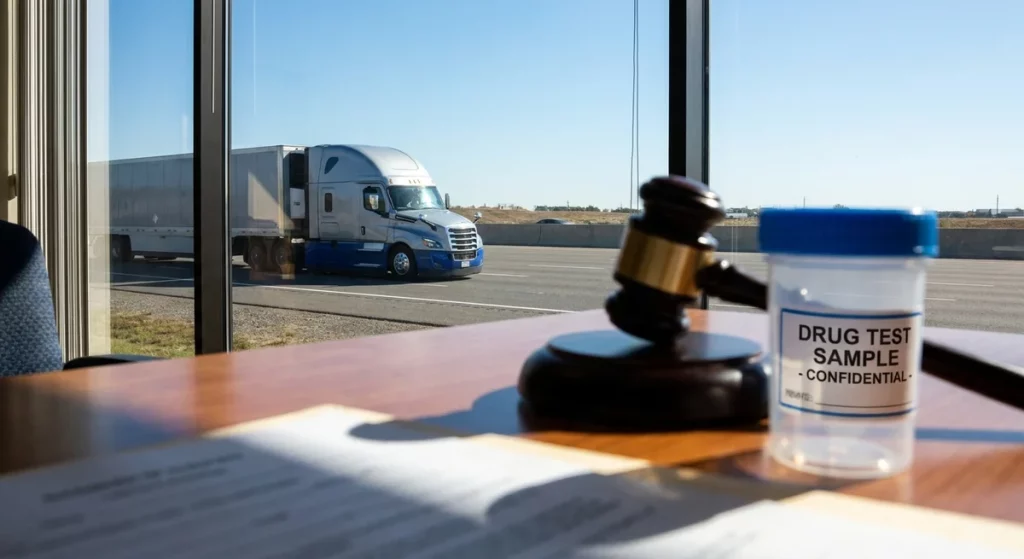
Marijuana Reclassification vs. CDL Law: Why the Rules Aren’t Changing for Drivers
The recent headlines regarding the U.S. Department of Justice (DOJ) moving to reclassify marijuana to Schedule III have sparked a lot of conversation across the country. In the trucking industry, many are asking: Is this a “green light” for commercial drivers? The short answer is: Absolutely not.
If you were hoping for a loosening of restrictions, the reality is quite different. For the transportation industry, the rules remain strict and unchanged. Below are the legal facts and data proving that total prohibition still applies in the cab of a truck.
Understanding the Shift: Schedule I to Schedule III
The DOJ recently decided to move marijuana from Schedule I (the category for dangerous substances with no accepted medical use, like heroin) to Schedule III (substances with a recognized medical use, such as anabolic steroids or codeine). While this is a milestone in federal law, it is not legalization.
Marijuana remains a controlled substance. Crucially, Department of Transportation (DOT) regulations operate independently of this reclassification. Transportation Secretary Pete Buttigieg has confirmed that the DOT’s authority to test drivers for marijuana is derived from specific statutory requirements that are not affected by this change.
Hard Facts for the Transportation Industry
The legal framework governing commercial driving remains focused on public safety. Here is how the facts stand today:
Safety-Sensitive Designation
Every CDL driver performs “safety-sensitive” functions. According to 49 CFR Part 40, the use of marijuana by these individuals is strictly prohibited. There are no exceptions for medical marijuana cards or state-level recommendations.
The Mandatory 5-Panel Drug Test
Marijuana remains a permanent fixture in the mandatory 5-panel drug test. This test is required for pre-employment, random testing, and post-accident procedures. If THC is in your system, the test is a failure, regardless of the substance’s schedule classification.
The FMCSA Clearinghouse Reality
The data highlights the severity of the situation. Currently, more than 184,000 drivers are listed in the Drug & Alcohol Clearinghouse with a “prohibited” status. Marijuana accounts for nearly 60% of all violations recorded in the system. A positive test is often a career-ending event for those who cannot or will not navigate the recovery process.
Federal Authority and the CBD Risk
It is vital to remember that federal law takes precedence over state law. Even if marijuana is legal in your home state, that legality has no weight during a DOT inspection or a laboratory drug screen. Furthermore, CDL drivers must remain extremely cautious regarding CBD products. These products frequently contain trace amounts of THC—enough to trigger a positive drug test and result in the loss of driving privileges.
Conclusion: Protecting Your Career
While Schedule III reclassification may ease medical research and shift criminal policy at the federal level, nothing changes in the world of heavy transport. Road safety remains the top priority, and DOT regulations stay in full force.
A positive test result still means an immediate entry into the Clearinghouse and the suspension of your driving career until you complete the long and expensive Substance Abuse Professional (SAP) process. Protect your license, your career, and the safety of others on the road.
Safe travels from All About Trucks & TransLab! We put Truckers first!
