
The High Cost of Diesel: A Battle for Survival
With diesel prices remaining stubbornly high, the fight for every drop of fuel has become a grueling battle for business survival and profitability. As industry advisors, we frequently hear two questions from fleet owners: “How long will these prices stay this high?” and “How many miles can I actually squeeze out of a single gallon?” While nobody has a crystal ball for the first question, we have tackled the second one many times.
Breaking the 6.9 MPG Barrier
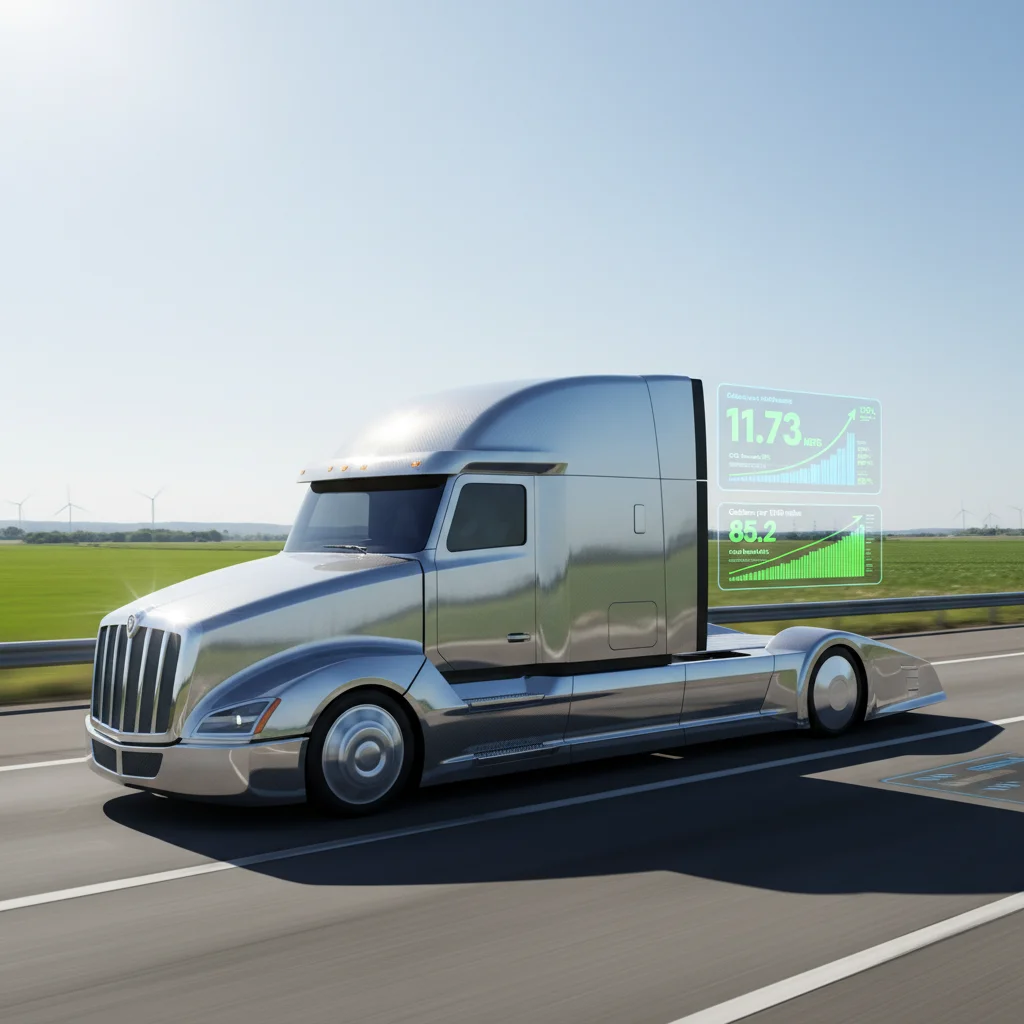
According to official statistics, the average fuel efficiency for U.S. trucking companies is a mere 6.9 MPG. However, reality proves that these limits can be pushed much further. A prime example is Mesilla Valley Transportation (MVT). During the prestigious Run on Less – Messy Middle test, one of their trucks achieved an impressive average of 11.73 MPG over three weeks of intense driving. MVT has demonstrated for years that with the right approach, it is possible to nearly double standard performance.
The Toolkit for High Efficiency
There is no single “magic bullet” for fuel efficiency. Instead, carriers and owner-operators can curate their own suite of technologies. The most obvious starting point is aerodynamics for both the tractor and the trailer. Engineers at MVT Solutions have rigorously tested dozens of solutions to reduce air resistance, including:
- Trailer side skirts
- Specialized roof fairings and wheel covers
- Gap management systems (between tractor and trailer)
- Aerodynamic mudflaps and advanced trailer tails
Beyond Aerodynamics: Technology Investments
Aerodynamics is just one piece of the puzzle. Other powerful investment tools include:
- Automatic Tire Inflation Systems (ATIS): Maintaining optimal pressure consistently.
- Low Rolling Resistance (LRR) Tires: Reducing the energy lost through tire deformation.
- Advanced Synthetic Lubricants: Minimizing friction within the drivetrain.
- Rooftop Solar Panels: Reducing the load on the alternator and powering onboard systems.
The Metric Shift: Why Gallons per 1,000 Miles Matters
Traditionally, fleets operate using MPG or percentage-based savings. However, these units can be misleading. Why? Because they are highly sensitive to variables like driver style, route diversity, and, most importantly, cargo weight. Professionals at MVTS use a more reliable metric: gallons consumed per 1,000 miles (gal/1,000 miles).
Consider this: the savings generated by aerodynamic modifications, when expressed in gal/1,000 miles, are completely independent of freight weight. A 34,000 lb empty Class 8 truck will save the exact same number of gallons over 1,000 miles due to fairings as a truck loaded to the 80,000 lb limit. If we measured this in MPG or percentages, the results would fluctuate wildly based on tonnage, making it difficult for carriers to accurately predict their Return on Investment (ROI).
The Bottom Line: Data Doesn’t Lie
In rigorous laboratory and road tests, the following savings benchmarks were recorded:
- High-level optimizations: Savings of 11.68, 8.70, and 6.61 gal/1,000 miles through advanced aero and tech systems.
- Component-level modifications: Savings of 1.12, 0.96, and 0.39 gal/1,000 miles for simpler items like vented mudflaps or basic wheel covers.
Globally, the implementation of these test-based technologies has saved fleets a total of 2 million gallons of fuel. According to data published in CCJ, this translates directly to $7.2 million in pure additional profit for carriers and the avoidance of 21,000 metric tons of CO2 emissions.
Conclusion: Your Path to Profitability
Ultimate success depends on two factors: how you configure your truck specifications and how you train your drivers in economical driving techniques. The business math is simple—the savings are right there on the road; you just have to start measuring them correctly and implementing the right tools. Safe travels from All About Trucks & TransLab! We put Truckers first!
