
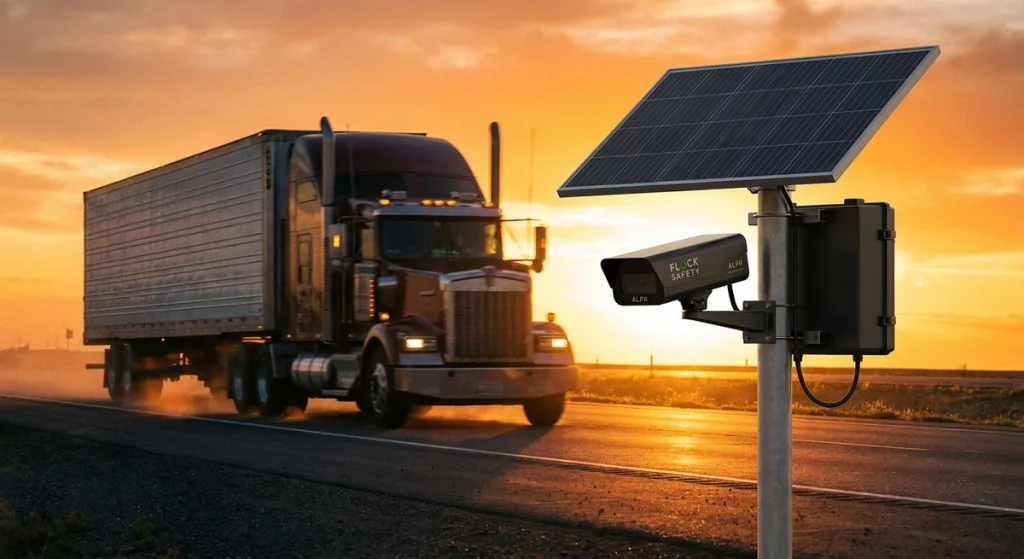
From Catching Criminals to Monitoring Logistics
Surveillance on American roads is entering a completely new phase. Devices originally designed to assist police in chasing stolen vehicles and searching for dangerous criminals are increasingly pointing their lenses at the transportation industry. Are Flock Safety’s automatic license plate readers (ALPR) another tool of oppression against drivers, or the unavoidable reality of digital transport?
In the small town of Robinson, Texas, local police began using Flock Safety cameras to scan and track semi-trucks passing through the area. This review of local transport policy followed numerous resident complaints about noise generated by heavy vehicles. A 30-day analysis revealed that out of 63 trucks passing through the city, more than half were heading to local destinations, bypassing restricted transit routes where large commercial vehicles are banned.
The Privacy Debate: Public Backlash vs. Professional Reality
The situation quickly sparked a heated discussion online. While some residents complain about noise, others defend the industry. One YouTube user pointed out, “If people don’t want to hear trucks, they should stop buying the things we have to deliver.” Others noted that the quality of life would be significantly worse without the logistical backbone of the country.
Flock Safety itself is facing a wave of criticism across the United States. In many regions, the cameras have been vandalized, and communities are creating maps of camera locations. According to DeFlock, a service tracking surveillance systems, over 100 cities in the US have already opted out of Flock services. In response, CEO Garrett Langley announced significant changes, including a default 7-day data retention period and stricter mechanisms to prevent police abuse.
Why Trucking Fleets View Privacy Differently
Interestingly, while private citizens protest mass surveillance, the reaction within the transport industry is more tempered. Many fleet managers note that professional drivers are already the most monitored workers on the road. With Electronic Logging Devices (ELDs), GPS telematics, in-cab dashcams, and constant scanning at weigh stations, the concept of privacy on the road has long since shifted.
Jay Stanley, a senior analyst with the ACLU, notes a key legal distinction: “The trucking industry is highly regulated. When a driver is at work, they are performing professional duties, not private errands. In a commercial context, the expectation of privacy is naturally limited.”
How Flock Safety Works: The Tech Behind the Lens
Understanding the impact of this technology requires a look at how it operates:
- Power and Installation: Stationary devices are powered by solar panels or batteries, mounted along public roads and neighborhood entrances.
- Capture Method: Instead of continuous video, the camera takes a series of 6–12 photos when a vehicle is detected, even at speeds up to 100 mph.
- Artificial Intelligence: The AI reads the license plate, make, model, color, and unique features like roof racks or dents.
- Real-Time Integration: Records are compared instantly against the National Crime Information Center (NCIC) for stolen cars or Amber Alerts.
The Legal Frontier: HOS Violations and Future Enforcement
Experts warn that the use of these cameras is expanding beyond crime prevention. Attorney Matthew Leffler, known as “The Armchair Attorney,” revealed that Flock camera data has already been used as evidence in Hours of Service (HOS) violation cases. The system recorded a truck in motion while the digital logbook showed the driver was on a break.
“I expect many more cases like this in the future,” Leffler warns. “Cities are already using footage to enforce local truck route restrictions. Expanding this to weight limits, route bans, and eventually even detecting mobile phone use is highly likely.”
One crucial legal point remains: while obtaining data from a phone or ELD usually requires a search warrant, police can access Flock camera data without one. Courts generally consider license plates in public spaces to be public information. As the industry moves forward, the line between public safety and industry oversight continues to blur, making transparency and compliance more important than ever for the modern trucker.
