
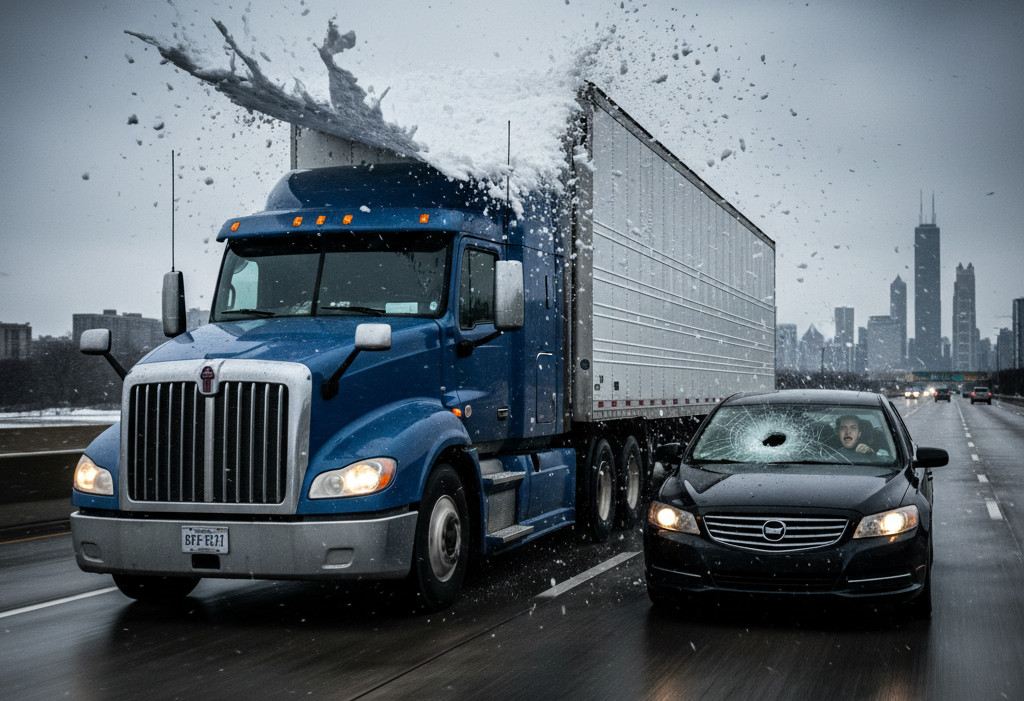
Winter on American roads isn’t just about black ice and blizzards in Dakota or the Midwest. For us, passenger vehicle drivers navigating the Interstates from San Francisco to Chicago to New York, there is a serious, often-forgotten hazard until we see it with our own eyes: “ice projectiles”—large sheets of ice and compacted snow falling from the roofs of semi-trailers.
This is not merely a question of a broken headlight; it is a real danger to life, as drivers across the U.S. tragically learn every year.
The Physics of the Hazard
Why is this so dangerous? The physics are unforgiving. On the flat roof of a box trailer, water and melting snow accumulate. At night, this freezes solid, forming a unified sheet of ice. When the truck begins moving on the Interstate, and the cab heats up or the force of the air lifts the ice sheet, a mass that can weigh from several pounds to several hundred pounds is released from the roof.
Traveling at 65-75 mph, this chunk of ice doesn’t just fall to the ground. It flies like a missile. If it strikes your windshield, the results are catastrophic—ranging from total vehicle destruction and permanent disability to death.
The Problem of Uneven Laws
The issue is serious in the U.S. and monitored by organizations like the AAA Foundation for Traffic Safety. It’s important to remember that regulations in the U.S. are not uniform.
States like New Jersey, Pennsylvania, Connecticut, and New Hampshire have strict laws mandating the clearing of trailer roofs (fines can exceed $1,000 if an accident occurs), but in many other states, the rules are vague, which only increases the risk.
How to Increase Your Safety Odds
You cannot control whether the driver ahead of you cleared their roof. However, you can control your position on the road. Here is how you can increase your chances of staying safe:
The 6-Second Rule (Increase Distance): Forget the standard following distance. In winter, when driving behind an 18-wheeler, you need to see more. If ice falls, you need time and space for it to hit the asphalt, not your hood. Give yourself a massive margin for error.
Avoid the “Impact Zone”: The worst place is directly behind the trailer. But beware—ice often falls to the sides due to wind gusts or on curves. If you are passing, do so decisively. Do not “hang out” in the blind spot or directly alongside the trailer.
Observe the Roof: Sometimes, you can see if something is lodged on top. If you notice a sheet of ice lifting or “snow mist” blowing off the top—back off. Slow down. Let that projectile fall ahead of you.
Keep Your Cool During Impact: If a strike is unavoidable, do not yank the steering wheel. A sudden swerve at 70 mph on a slippery road is a simple recipe for a rollover. Slow down, maintain your lane, and only after you have stabilized the vehicle should you pull over to the shoulder and turn on your hazard lights.
A Dashcam is Essential: If damage occurs, the truck driver often doesn’t even realize they lost something and keeps going. In the U.S., a dashcam is often the only way to prove fault to a State Trooper and your insurance company, obtain the DOT or license plate number, and avoid paying your deductible out of pocket.
The principle of limited trust on American roads ratchets up in winter. Every uncleared truck is a potential launcher. Don’t rely on “it’ll be fine.” Increase your distance, turn on your camera, and keep your eyes peeled.
Safe travels and wide roads from All About Trucks & Translab! We put Truckers first!
