
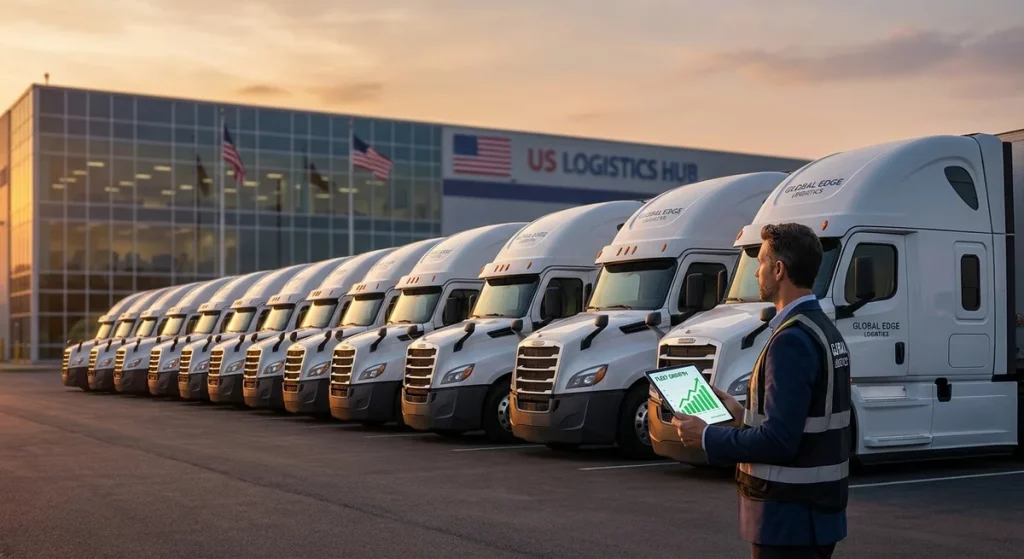
Scaling Your Trucking Fleet: Navigating the 3 Financial Thresholds of Success in the USA
Many owners of trucking companies dream of rapid fleet expansion. On paper, the logic seems flawless: if you have 5 trucks and are making a profit, doubling your fleet to 10 should double your income. However, the American market is often a brutal reality check. Experience shows that most companies that get “stuck” or fail at the 10-to-15-truck mark don’t suffer from a lack of ambition or cargo; they fail because they weren’t financially or structurally prepared for the costs of the next stage.
Market analysis and operational data reveal three distinct logistical thresholds in the trucking industry. Each requires a completely different strategy for managing capital and people.
Threshold One: The 10-Truck Limit – From Personal Control to Infrastructure
When you cross the 10-truck barrier, your company stops being a business you can control personally. Up until this point, many owners find themselves booking loads, handling invoicing, calling drivers, and even keeping track of oil changes. At 10 trucks, the ground begins to shift. Owners who cannot delegate tasks because they believe “no one does it better than me” usually stagnate.
The Capital Gap Trap
Operational discipline is the first thing to slip: service documentation accuracy, timely invoicing, and rate-per-mile discipline. With 5 trucks and 30-45 day payment terms from brokers, you can often cover budget holes with personal savings. At 10 trucks, operating costs (fuel, payroll, insurance, repairs) surge to $80,000–$150,000 per month. Before the first invoice payments arrive, you must shell out massive sums to maintain liquidity.
This is where factoring stops being an option and becomes a necessity. Paying a 3% fee on $100,000 a month is $36,000 a year just for liquidity. If you have the reserves, don’t use factoring out of habit; if you don’t, calculate this cost into every mile. Additionally, at this stage, you need a dedicated dispatcher and a professional Transport Management System (TMS).
Threshold Two: 11 to 25 Trucks – The “Vulnerability Zone”
This is arguably the most dangerous phase in the trucking industry. You are too large to operate as a flexible, low-overhead family business, but still too small to reap the benefits of scale—such as direct contracts with major shippers or massive volume discounts on fuel and parts.
Rising Fixed Costs and Insurance Risks
At this stage, fixed costs (overhead) jump significantly. You now require a professional office, a safety manager, at least two dispatchers, and dedicated accounting. While your overhead increases drastically, the revenue from 15 trucks may barely cover these new essentials.
Furthermore, insurance risk becomes a magnifying glass. One serious accident or a series of negative DOT inspections (particularly regarding Hours of Service or Maintenance) can skyrocket your insurance premiums by double digits. At this scale, such an increase can lead a company to bankruptcy in a single month.
Threshold Three: 50+ Trucks – Corporate Management and Tax Optimization
Exceeding 50 trucks moves you into the league of mid-sized carriers. Here, the business is no longer driven by intuition, but by pure statistics, compliance procedures, and tax optimization. Large fleets are better positioned to leverage legislation like the *One Big Beautiful Bill Act*, utilizing 100% bonus depreciation and Section 179 limits (up to $2.56 million) to drastically reduce tax liability.
Conclusion: Is Your Foundation Ready?
If you are planning to grow in the coming months, ask yourself one critical question: Will my financial structure hold if brokers delay payments by two weeks and operating costs rise by 10%?
In today’s market, the winners are not necessarily those with the most trucks, but those with the highest network efficiency, the best liquidity protection, and impeccable safety scores. Before you buy your next truck, ensure your back office and financial foundation are ready for the weight. Safe travels and wide roads from All About Trucks & Translab—we put truckers first!
