
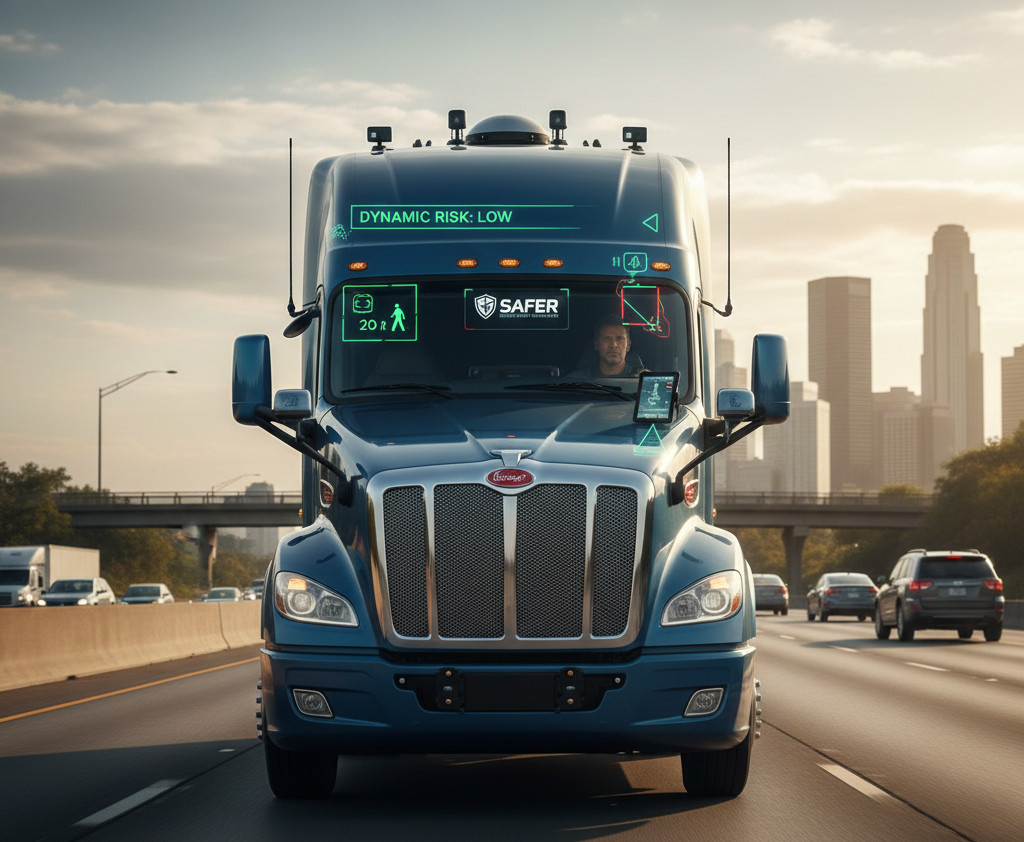
Remember when a truck camera was just a simple dashcam, there to prove a driver’s innocence after an accident? Well, those days are rapidly becoming a relic of the past. We’re on the cusp of a true revolution, with companies like Samsara, Lytx, and Nauto leveraging artificial intelligence to predict accidents before we even think about hitting the brakes! The goal? Zero accidents. Sounds like science fiction, right?
Johan Land from Samsara emphasizes that 90% of accidents are due to human error, and AI has the potential to change that dramatically. While we might not eliminate every single incident, those “human” errors? We can almost erase them! This would be more impactful than seatbelts, airbags, or ABS combined.
Samsara is diligently working towards this vision. Their team meticulously studies drivers, analyzing tons of data: from behavioral patterns and training history to weather conditions and telematics. All of this is fed into models designed to predict risk, allowing for proactive planning and targeted training.
Lytx is also a major player in this space. Their AI, in addition to detecting fatigue or phone use in the cabin, analyzes the distance from the vehicle ahead, using data from cameras, the engine, GPS, and accelerometers. A new innovation from Lytx, called Dynamic Risk, considers weather conditions and will soon incorporate data on pedestrians and construction zones. Their aim is to provide transportation companies with a “holistic view of risk.”
However, the true master of prediction seems to be Nauto with its Predictive Fusion AI. This system integrates everything: what’s happening externally (traffic lights, brake lights of the car ahead, pedestrians) with what’s happening internally (vehicle speed, driver alertness, etc.). Stefan Heck, CEO of Nauto, boasts impressive results: an 80% reduction in collisions with pedestrians and cyclists, and an overall 65% decrease in accidents! Their SAFER system – Situational Assessment Fusing Exponential Risks – analyzes how these risks evolve over time, enabling intervention before it’s too late.
Nauto’s system operates on three levels. The first level provides immediate assistance to the driver. The AI offers real-time feedback, warnings, and suggestions for safer driving. And it works! Heck highlights that a remarkable 85% of drivers utilize these tips and genuinely improve their skills.
The second level springs into action when a minor collision occurs. Nauto immediately sends an accident notification and, crucially, provides evidence that can completely exonerate the driver. It turns out that the majority of accidents involving Nauto users are caused by… other road users! Interestingly, the system also helps avoid these “other-party-at-fault” collisions by teaching drivers to anticipate and prevent risk.
The third level is a dream come true for transportation company managers. They gain a complete overview of risk across the entire fleet, and can even precisely narrow it down – to a specific driver, region, city, or operational center. It’s a powerful tool for large-scale safety management!
Heck believes this is just the beginning. Soon, AI will integrate with active safety systems in trucks. Imagine a vehicle that automatically tightens seatbelts or pre-engages brakes because AI has predicted an accident! This will require even more sensors (Lidar will soon be affordable!) and even more advanced artificial intelligence.
In his opinion, intelligent systems will become standard in trucks within the next five years. Currently, loss reduction is around 20%, while Nauto achieves 65%. Heck believes we can reach a 95-98% reduction in accidents. A full 100% might be a pipe dream, but high 90s are absolutely realistic. The future of AI-powered transportation promises to be incredibly safe and, frankly, less stressful for everyone!
