
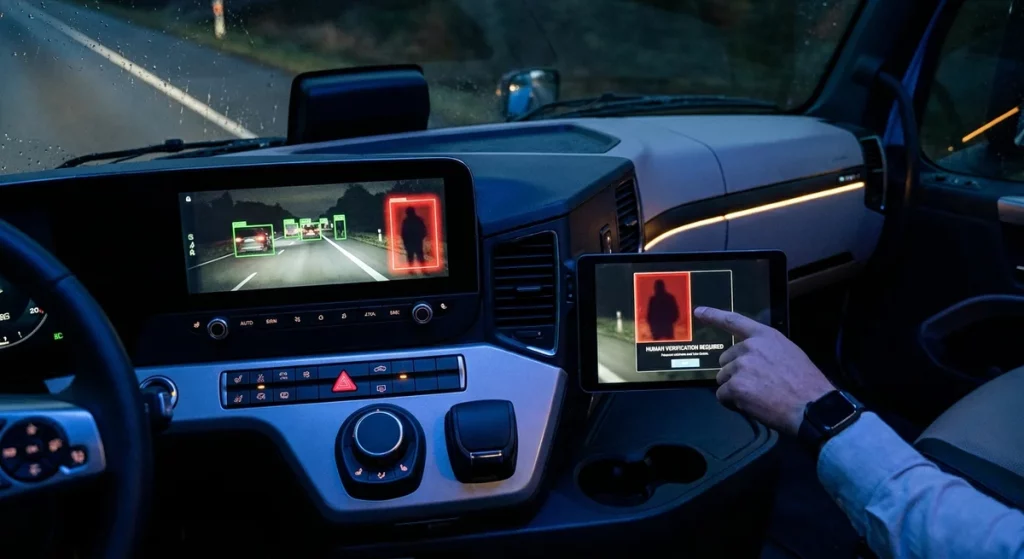
The Rise of AI in the Cab: A Double-Edged Sword
In recent years, the transportation industry has been swept up in a wave of fascination with Artificial Intelligence. From advanced telematics to AI-powered dash cams, technology has flooded the cabins of American trucks. The promise was simple: catch dangerous driving behavior in real-time, protect carriers from accidents, and provide ironclad evidence of innocence in legal disputes. However, as highlighted during the recent Management Conference & Exhibition (MCE) hosted by the American Trucking Associations (ATA), relying solely on automated detection without human oversight is becoming a silent legal trap for trucking companies.
The ‘False Negative’ Trap: What Your AI Isn’t Telling You
Industry experts, including attorney Doug Marcello and Sean Ritchie, Vice President of Solera Fleet Solutions, warn of a critical flaw: the false negative. This occurs when an AI system monitors a driver but fails to recognize a genuine hazard or violation, leaving the event unflagged in the manager’s dashboard. Research suggests that approximately 30% of video recordings captured by AI systems contain secondary risk factors that the software missed entirely.
The Accumulation of ‘Judgment Debt’
Most safety departments operate under extreme time pressure, relying on pre-filtered reports. This means raw footage containing unflagged but dangerous driving habits sits untouched in digital archives. Sean Ritchie describes this as “judgment debt.” Automation provides a false sense of security while incriminating evidence silently accumulates in the background. As Ritchie notes, by removing human intelligence from the equation, companies lose control over the very risks they are trying to manage.
The Courtroom Reality: Why ‘The AI Missed It’ is No Defense
In the event of a serious accident, plaintiff attorneys don’t just look at the crash itself. Through the discovery process, they demand access to months of telematics and video archives to build a narrative of systemic negligence. Doug Marcello warns that a technical glitch is no shield in court. “If the dangerous behavior was captured on video, you are responsible for it. The excuse of ‘the AI didn’t catch it’ will be flatly rejected by a judge and jury,” Marcello explains.
Tactics and the ‘Reptile Theory’
Using trial tactics like the “reptile theory”—which aims to trigger a sense of danger in jurors—attorneys look for a pattern of indifference. A single recurring pattern, such as documented fatigue, speeding, or hard braking that sat on a server but was never addressed through coaching, is presented as evidence of corporate negligence. A tragic case in Philadelphia saw a jury award $26 million against a carrier because of ignored speeding records from the previous year, even though experts agreed speed wasn’t the direct cause of the accident in question.
The ‘Discovery Fallacy’ and the Path Forward
Many carriers fall into the “discovery fallacy”—the mistaken belief that not looking at the archives protects them. The reality is that the data exists, and it will be unearthed during a lawsuit. Companies have a choice: proactively analyze their own data and provide coaching, or let a plaintiff’s attorney do it for them in court. Automation is a powerful tool, but in the American legal landscape, it requires human verification. As the saying goes: “Trust, but verify.” In the age of AI, this principle is the most important insurance policy a trucking company can have.
Wishing you a wide and safe road,
All About Trucks & Translab – We put Truckers first!
